
Special Products
A special display is the answer when a standard monitor does not fit the installation. The size is not in the catalogue, the panel has to be seen through, the cabinet has to stand in a hall without glasses, or the shape has to follow a brand element rather than a 16:9 rectangle. This section collects those formats: transparent OLED, naked-eye 3D advertising cabinets, splicing video walls, strip and shaped panels, and custom optically bonded assemblies built into a housing.
Transparent OLED: what it is good for, and where it stops
A transparent OLED panel emits light only where the content is bright, so the object behind the glass stays visible. That makes it a retail and exhibition format: a showcase, a fridge door, a museum vitrine, a bank counter. Two things decide whether the project works. The first is transparency versus brightness — the clearer the panel, the less light reaches the viewer, so a window facing daylight needs a different content design from an indoor cabinet. The second is the background: transparent panels amplify whatever sits behind them, and a busy backdrop destroys legibility faster than any specification issue. Content is usually built with a dark or sparse background and short animations, and the installation is planned so the object behind the screen is the message.
Naked-eye 3D advertising cabinets
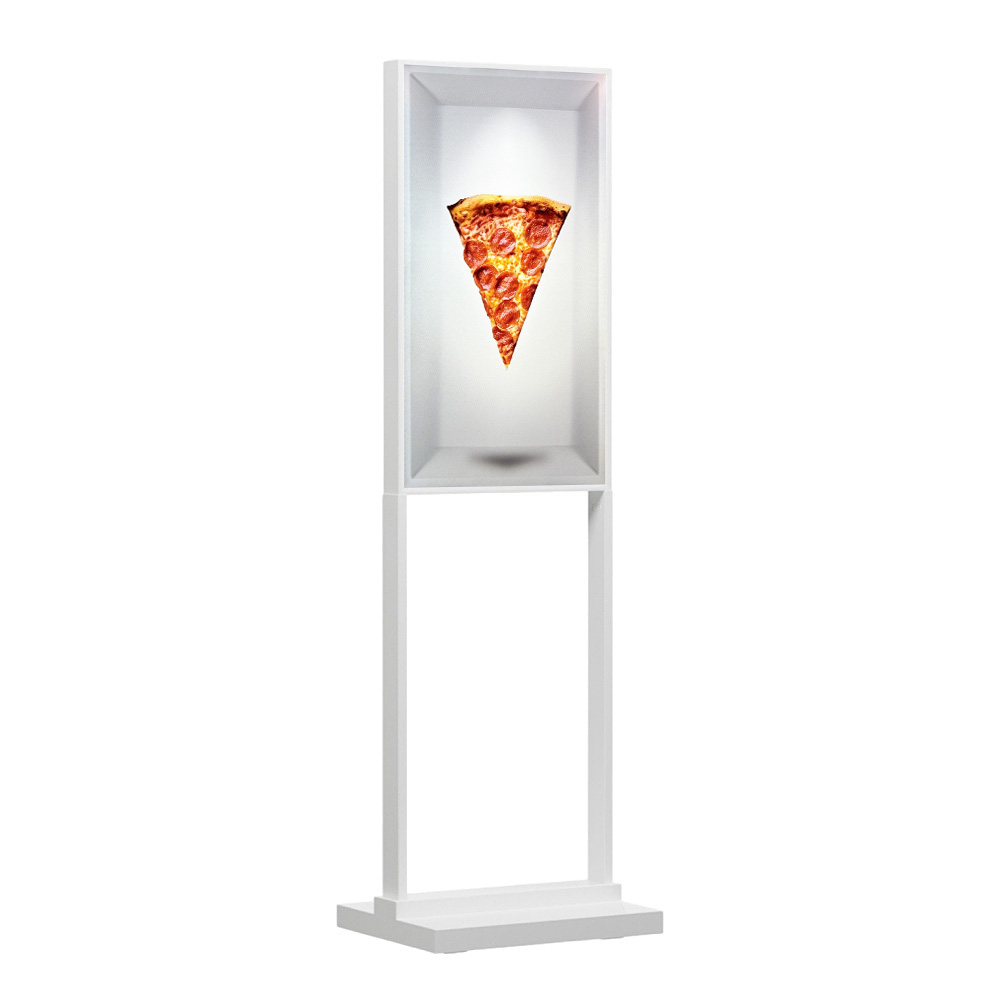
The 3D effect here is not a lenticular sheet and not a pair of glasses: a bright panel is combined with a shaped cabinet, a reflective or dark inner surface and content rendered for the specific viewing cone, so the image appears to leave the screen. The practical range covers 32, 36.3, 43, 50, 55 and 65 inch portrait cabinets for halls, airports, malls and exhibition entrances. Because the effect depends on the viewing position, the first design question is where people stand and how far away — a cabinet tuned for a three-metre corridor is not the same build as one for a ten-metre atrium. Full specification sheets for the whole size range are available on request.
Splicing walls and large formats
When the requirement is one large image rather than a bigger screen, the format is a video wall built from identical cabinets. Bezel width, the row-and-column layout and the content aspect ratio have to be decided together; the splicing wall section covers the trade-offs in detail, including curved and near-seamless options.
Strip, round and shaped panels
Shelving, shelf edges, vehicle interiors, escalator sides and reception desks rarely accept a standard 16:9 panel. Strip formats from 15 to 40 inch diagonal, round and square displays, and stretched bar screens are cut from the same panel families and then bonded, housed and sealed to suit the space. What usually constrains the project is not the glass but the housing depth, the service access, and how the unit is fixed — those are worth settling before the panel is specified.
How a custom unit is quoted
A useful quotation needs six things: the installation environment (indoor, window, outdoor, washdown), the required visible area and the housing envelope available, whether the surface is touched, how the unit is mounted and serviced, the interface and player arrangement, and the expected quantity with the target date. With those, a drawing comes first, then the glass and bonding route — air gap or optically bonded, OCA or LOCA, sealed to IP65 where the site demands it — then the housing, then a validation unit before the batch. Where only the electronics are custom, a standard industrial touch monitor or panel PC is usually the faster and cheaper route, and it is worth checking that option before going custom.
Where to start
Send a photograph of the location, the dimensions you have, and a sentence about what the screen has to achieve. That is enough to say whether a standard format will do, which special format fits, and what the realistic lead time looks like.