

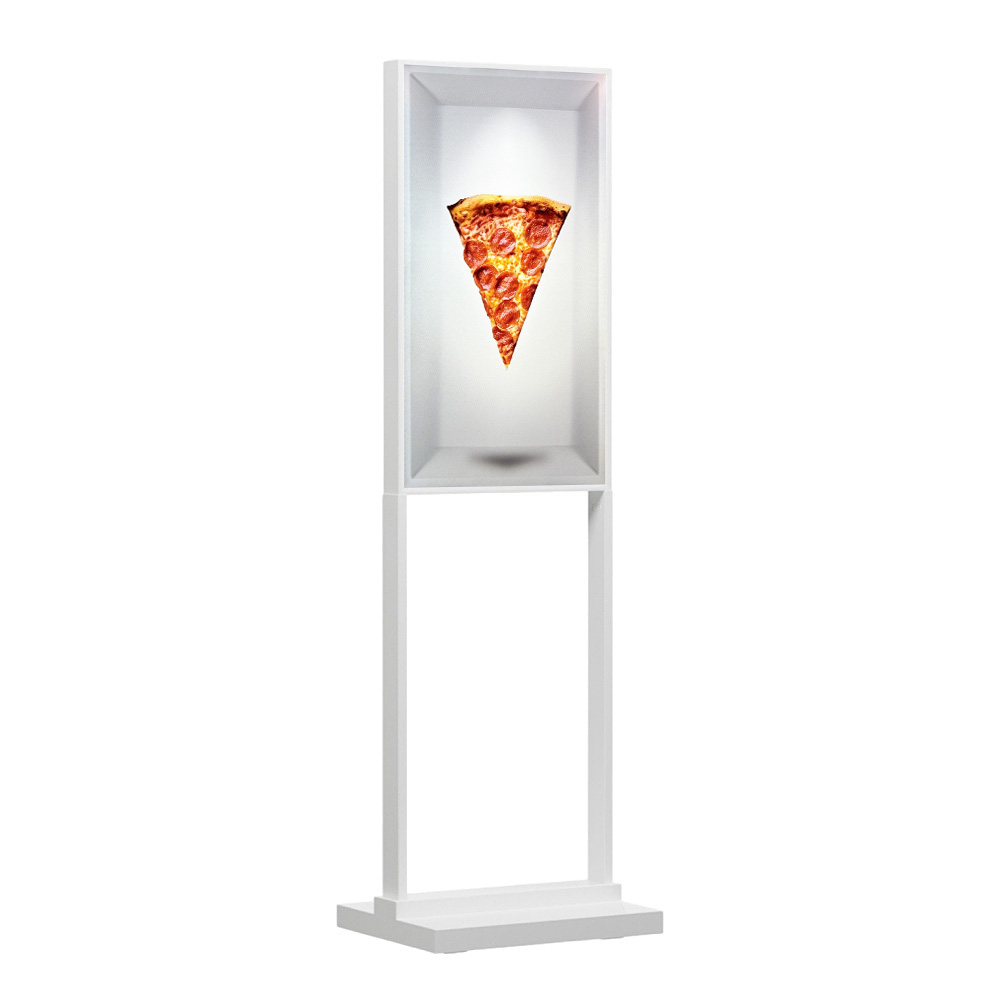
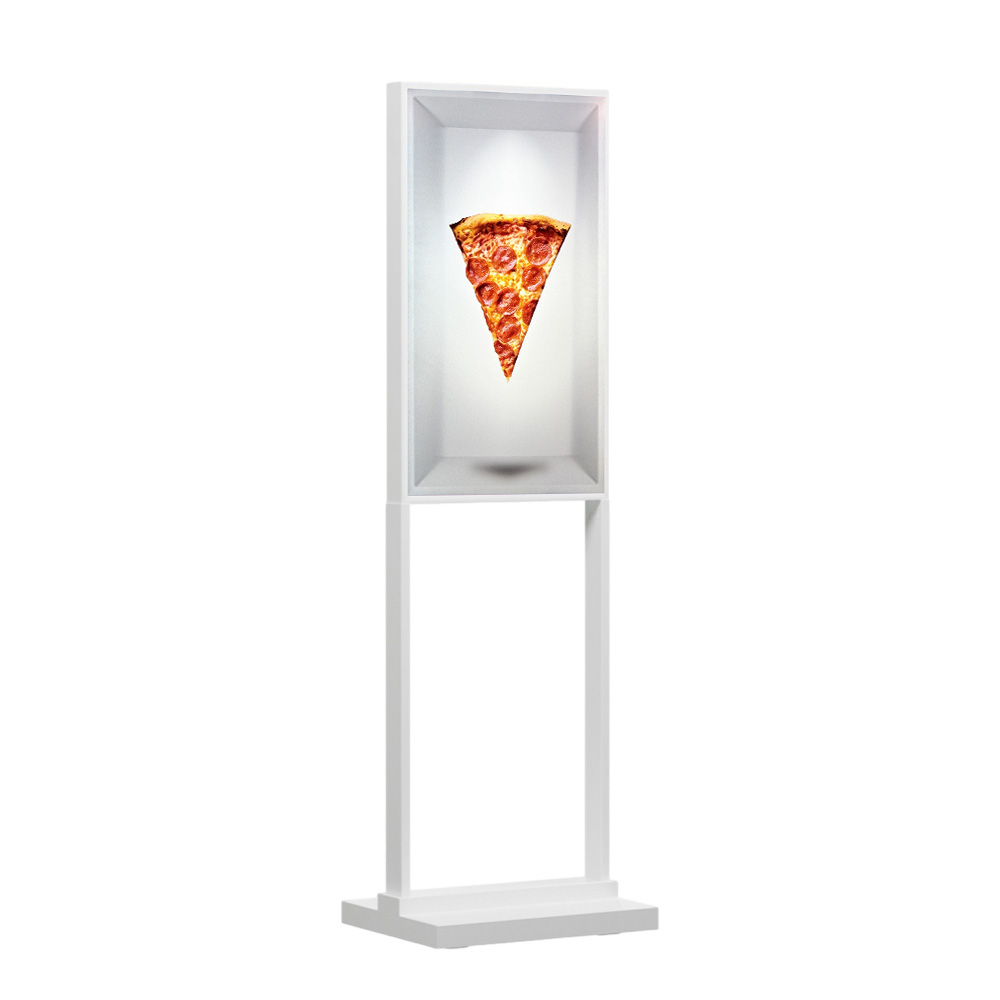
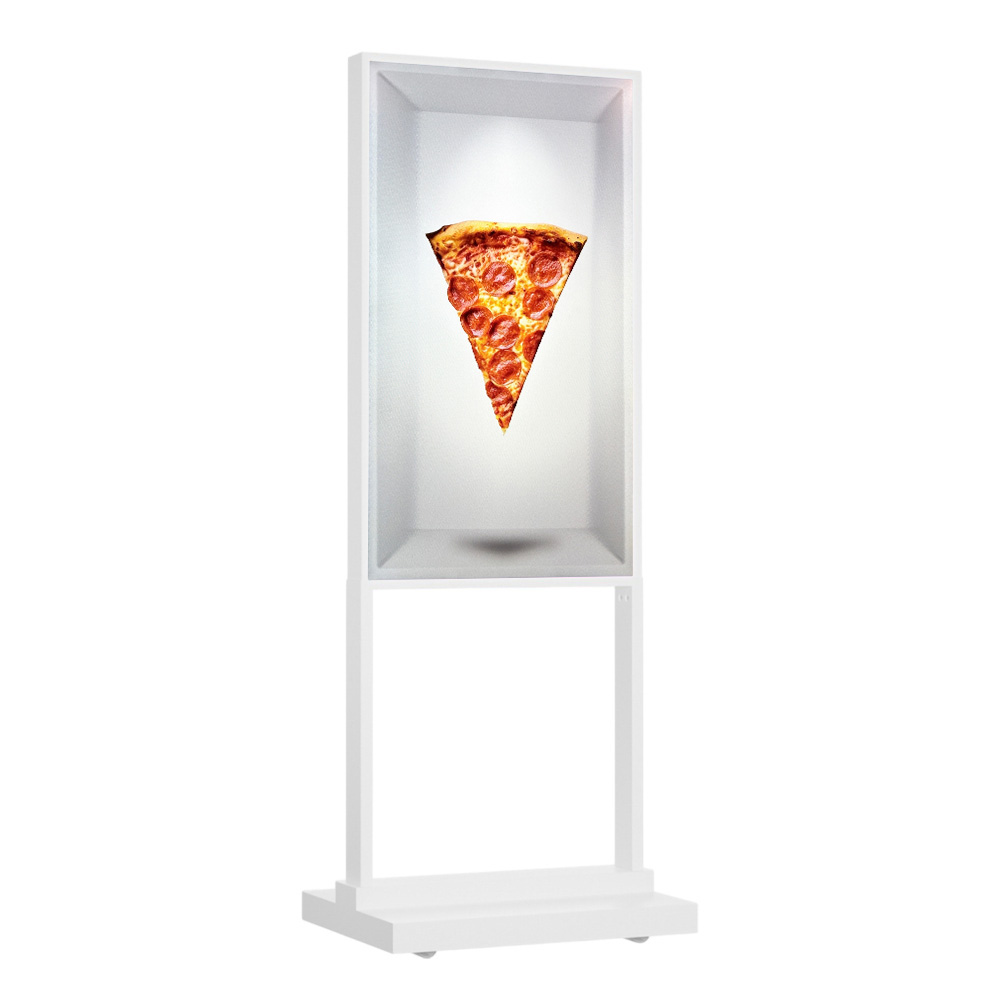
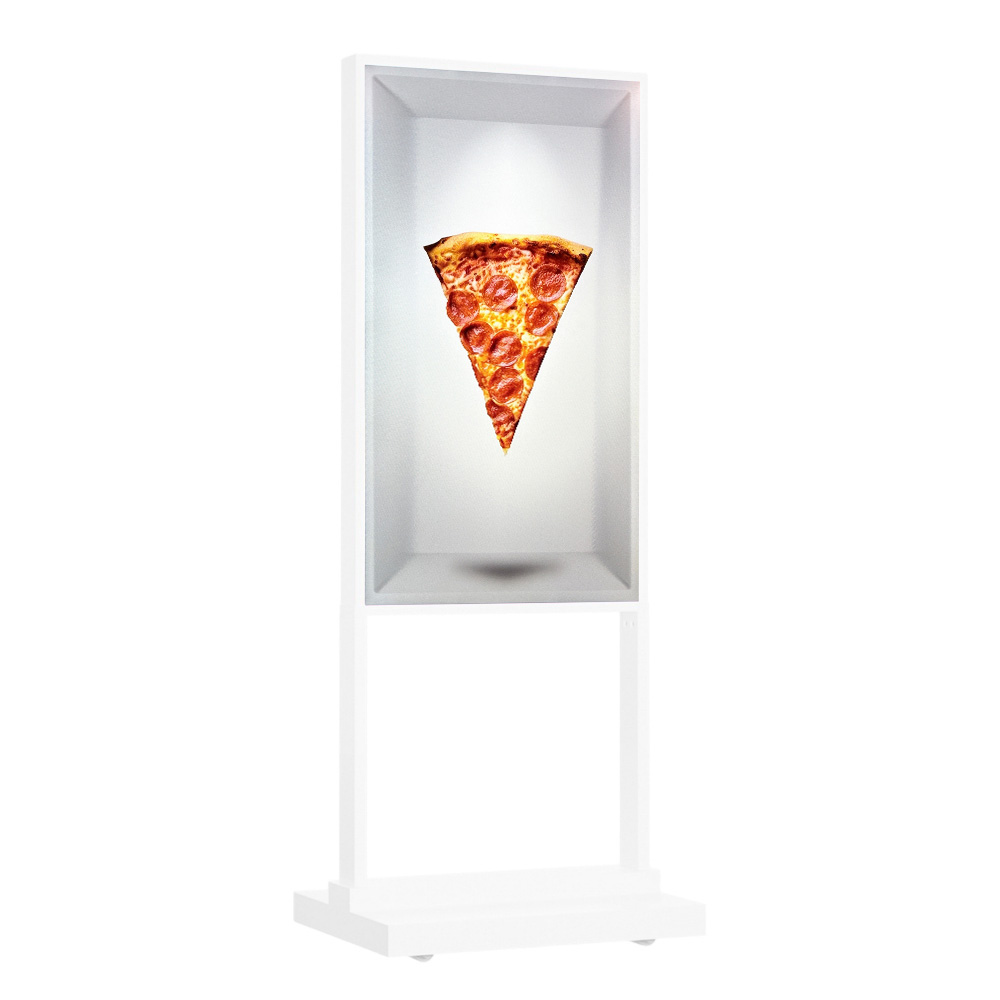
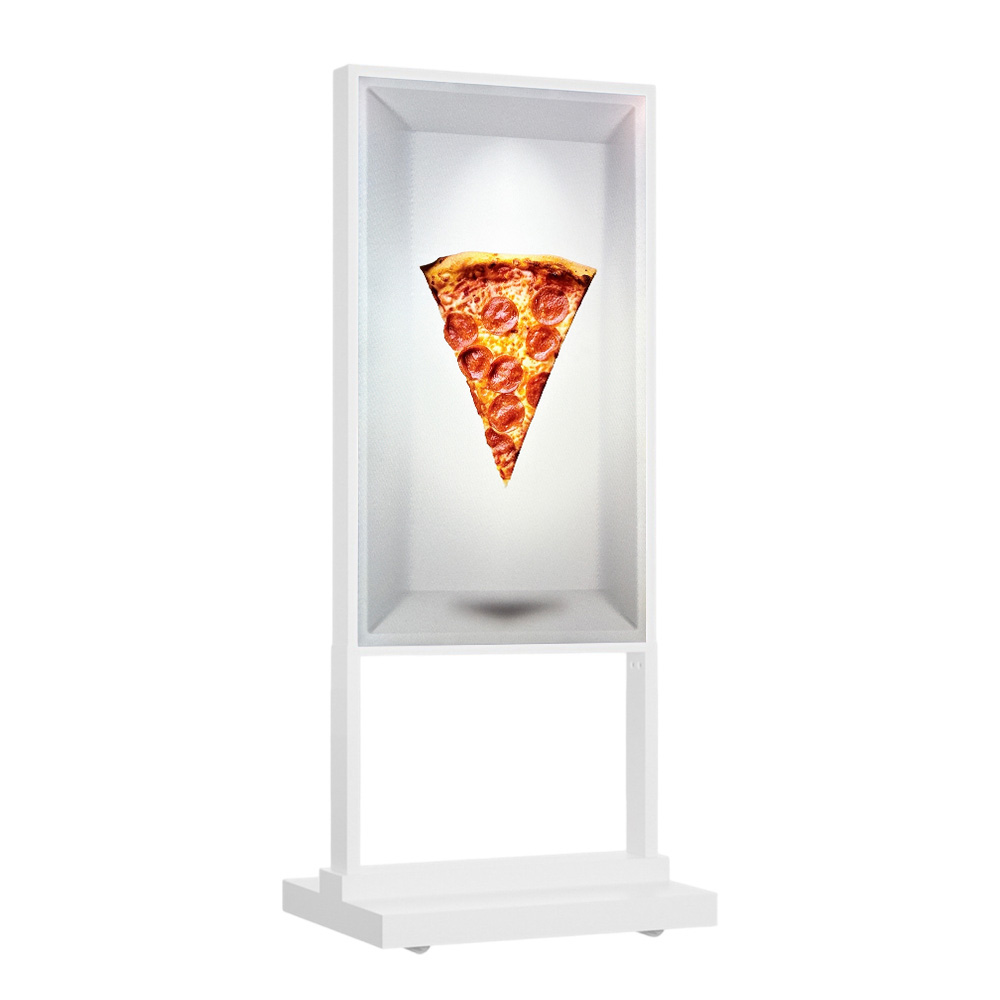
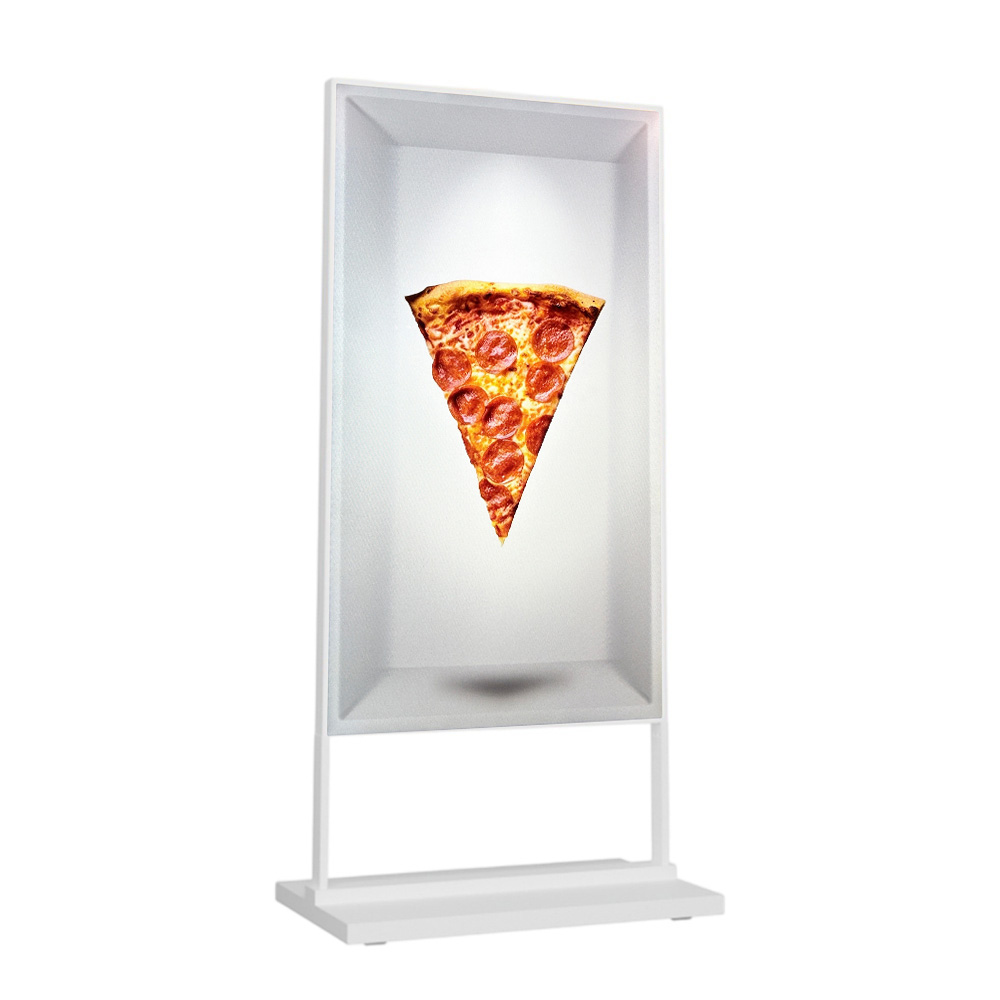

A 3D space display is a portrait cabinet that shows an image appearing to float in front of the screen — no glasses, no head tracking, no lenticular sheet. The L0A series runs from 32 to 65 inch in a 54 mm chassis, with the panel, the cabinet and the 3D rendering tuned as one system. It is used where a normal screen has stopped being noticed: mall atriums, airport halls, exhibition entrances, brand flagship windows.
Configuration matrix
Six sizes, one cabinet design. Brightness is ordered per unit; TBD entries are awaiting the final supplier drawing and are quoted on request.
| Model | Size | Active area (mm) | Resolution | Brightness (nits) | Power | Net / Gross | Outline W×H×D (mm) | Datasheet |
|---|---|---|---|---|---|---|---|---|
| STD-3D32-L0A | 32" | 329.5 × 698.4 | 2160×3840 | 500 / 700 / 1000 | ≤85 W | 16.8 kg / 20.06 kg | 1480 × 448 × 350 | |
| STD-3D36.3-L0A | 36.3" | 452.3 × 803.5 | 2160×1216* | 500 / 700 / 1000 | ≤85 W | TBD / TBD | TBD | |
| STD-3D43-L0A | 43" | 529.25 × 940.9 | 2160×3840 | 500 / 700 / 1000 | ≤145 W | 26.8 kg / 28.16 kg | 1724 × 600 × 420 | |
| STD-3D50-L0A | 50" | 616.4 × 1095.8 | 2160×3840 | 500 / 700 / 1000 | ≤135 W | 32.3 kg / 34.3 kg | 1728 × 676 × 450 | |
| STD-3D55-L0A | 55" | 680.4 × 1209.6 | 2160×3840 | 500 / 700 / 1000 | ≤170 W | 36.8 kg / 37.8 kg | 1842 × 740 × 460 | |
| STD-3D65-L0A | 65" | 803.5 × 1428.5 | 2160×3840 | 300 / 500 / 700 / 1000 / 1500 | ≤195 W | TBD / TBD | 1866 × 834 × 550 |
* 36.3 inch native resolution is listed as 2160×1216 in the supplier drawing while the active area is 9:16; confirm with us before producing content for that size.
Two platform generations
The series spans two hardware generations, so do not assume one specification covers all six sizes. Sizes 32, 43, 50 and 55 run Android 11 on RK3568VC; the 36.3 inch unit runs Android 14 on the same board; the 65 inch unit moves to RK3576 with eight cores and 4 GB of memory.
| Size | OS | Board | CPU | Memory / Storage |
|---|---|---|---|---|
| 32 / 43 / 50 / 55" | Android 11.0 | RK3568VC | Quad-core Cortex-A55 2.0 GHz | DDR 2 GB (4 GB option) / eMMC 32 GB |
| 36.3" | Android 14.0 | RK3568VC | Quad-core Cortex-A55 2.0 GHz | DDR 2 GB (4 GB option) / eMMC 32 GB |
| 65" | Android 14.0 | RK3576 | Octa-core 2.2 GHz | DDR 4 GB / eMMC 32 GB |
What the 3D effect depends on
The effect is not a property of the panel alone. It comes from three things working together: a bright panel (the 43 to 65 inch units are usually ordered at 1000 nits), a cabinet with a shaped inner surface, and content rendered for the specific viewing cone of that cabinet. Change one and the image stops leaving the screen. That is why the size and the content have to be decided together — a cabinet tuned for a three-metre corridor is not the same build as one for a ten-metre atrium.
Content is the part that decides the result
Two rules cover most of it. First, the frame must be composed for portrait 9:16, not cropped from a landscape spot. Second, the subject needs depth cues that survive a fixed viewing position: layered foreground and background, a dark surround, and slow motion rather than fast cuts. Files play from the built-in Android player; 4K decoding is supported on every size. A ready-made 15-second loop is worth testing on site before committing to a batch of content.
Mounting, power and service
Every unit is a floor-standing cabinet with concealed castors and levelling feet, so it can be rolled into position and levelled on an uneven floor. Power is 100–240 V with standby below 1 W; the 65 inch unit draws up to 195 W at full brightness. Leave service access at the rear for the board and cable entry, and keep the front face out of direct sunlight where possible — a glossy 3D cabinet facing a window loses contrast faster than the specification suggests.
Where it fits in the range
If the requirement is a flat wall of information or advertising rather than a free-standing object, the indoor digital signage and outdoor signage ranges cover that ground, and splicing walls cover large single images. The 3D cabinet is the choice when the screen itself has to be the attraction. See the other formats we build to order on the special and custom displays page.
Frequently asked questions
Do viewers need glasses or a specific position?
No glasses. The image is designed around a viewing cone, so there is a best standing area — typically several metres in front of the cabinet. Outside that area the picture still looks correct, it simply loses the pop-out depth.
Can I reuse my existing video?
Usually not without re-rendering. Landscape footage cropped to 9:16 loses the composition the effect depends on. We can advise on the frame layout before you commission new content.
Is it suitable outdoors?
No. This is an indoor cabinet. For outdoor advertising use the outdoor signage range, which is sealed and rated for weather and sunlight.
Can the cabinet be branded?
Yes — housing colour (white standard, black optional), logo and side graphics are all order options. Send the artwork with the enquiry.
What if I need a size that is not listed?
Tell us the visible area and the space the cabinet has to fit; the special products range exists for exactly that. The six standard sizes cover most installations.
Custom builds are our core business.Custom size, I/O layout, brightness, wide temperature range, brand silkscreen — send your drawing and we quote within 24 hours. Request a custom quote →
INQUIRY
Related PRODUCTS
-
IP65 Optical Bonding Embedded Monitor — 32/43 Inch
-
IP65 Optical Bonding Android Panel PC — 15.6/21.5 Inch
-
Ultra-Thin ARM Panel PC — A26 Series
-
21.5 Inch IP65 Optical Bonding Touch Panel PC — Intel Core i7
-

Ultra-Thin T23 Advertising Display — 18.5 to 75 Inch
-
32 Inch IP65 Optical Bonding Touch Monitor — 1000 Nits
-
Ultra-Thin AG Touch Display T28 — 32 to 65 Inch