Welcome STARK TOUCH DEVICE!


Blog
Cost-effective selection of industrial control computers for low-cost industrial control scenarios
Cost-Effective Industrial Control Computer Selection for Low-Budget Automation Scenarios
Performance Requirements for Basic Automation Tasks
In low-cost industrial automation scenarios, the primary focus is on handling routine data collection and simple control logic. For example, in a small-scale packaging line, the system needs to monitor sensor inputs for package dimensions and trigger conveyor belts or labeling machines accordingly. These tasks typically require processors with moderate clock speeds, such as dual-core or quad-core CPUs operating at 1.5GHz to 2.5GHz. These processors can efficiently manage basic arithmetic operations, conditional branching, and low-latency communication with peripherals.
Memory requirements are also modest. A system with 4GB to 8GB of DDR4 RAM is sufficient for running the operating system and a few concurrent applications. This allows for smooth operation of the control software, which may include human-machine interface (HMI) displays showing real-time production data and simple alarm systems. Storage needs are minimal, with 128GB to 256GB SSDs providing enough space for the OS, control software, and a limited amount of historical data logging.
Expansion Capabilities for Future-Proofing
Even in low-budget setups, it's crucial to consider future expansion. One key aspect is the availability of PCIe slots or M.2 interfaces. PCIe slots can accommodate additional cards for specialized functions like high-speed data acquisition or advanced communication protocols. For instance, if the packaging line later needs to integrate with a new quality inspection system that uses high-resolution cameras, a PCIe-based frame grabber card can be added to capture and process the image data.
M.2 interfaces are useful for adding wireless connectivity options. In a remote monitoring scenario, where the industrial control computer needs to send data to a central server over the internet, an M.2-based 4G/5G module can be installed. This enables real-time data transmission without the need for complex wired network infrastructure. Additionally, M.2 slots can support WiFi modules, allowing for easy connection to local networks for software updates or remote access.
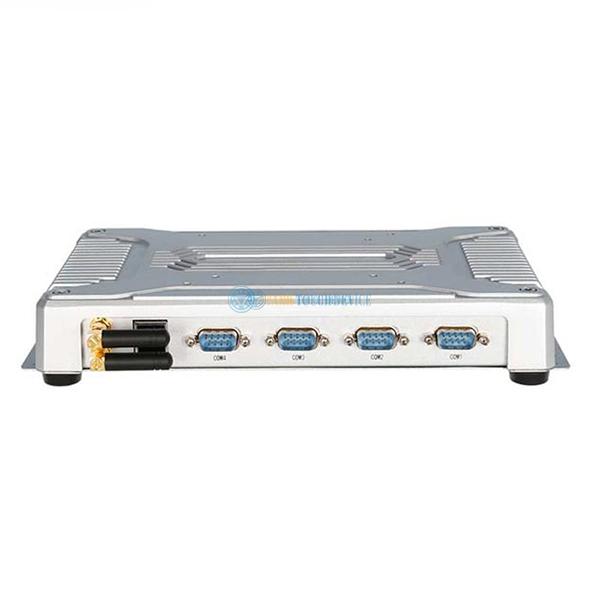
Another important expansion consideration is the number and type of serial ports. RS-232 and RS-485 ports are commonly used in industrial settings for connecting legacy devices such as barcode scanners, temperature sensors, and motor controllers. Having multiple serial ports on the industrial control computer eliminates the need for external serial-to-USB converters, reducing complexity and potential points of failure. For example, a system with 4 to 8 serial ports can easily connect to a variety of devices in a small manufacturing cell.
Environmental Adaptability for Industrial Settings
Industrial environments often present challenging conditions, even in low-budget scenarios. Dust and debris are common in factories, and they can clog cooling fans and damage internal components. Therefore, choosing an industrial control computer with a fanless design is a wise decision. Fanless systems rely on passive cooling mechanisms, such as heat sinks and heat pipes, to dissipate heat. This not only reduces the risk of dust ingress but also eliminates the noise generated by fans, creating a quieter working environment.
Vibration resistance is also essential, especially in applications where the computer is mounted on moving equipment or near vibrating machinery. Look for systems with ruggedized enclosures and components that are designed to withstand vibrations within the expected frequency range. For example, a computer installed on a conveyor system should be able to handle the vibrations caused by the movement of packages without experiencing hardware failures.
Temperature tolerance is another critical factor. Industrial settings can experience wide temperature variations, from cold storage areas to hot manufacturing zones. An industrial control computer should be able to operate within a temperature range of -20°C to 60°C or wider. This ensures reliable performance even in extreme conditions, reducing the need for additional temperature control measures and minimizing downtime.